What's wrong with the linear probability model
Earlier this year I published a few posts on this platform about average marginal effects and the linear probability models. I recently came to the conclusion that they are not very accessible, because they report quite extinsively on a series of simulation studies. This is why I decided to archive them. I will soon start writing on a paper that reorganises the arguments of these archived posts in a more targeted and accessible manner.
The archived posts can be found here:
-
Logistic Regression, Average Marginal Effects, and the Linear Probability Model - Part I: The basics
- This post describes the mathematical-statistical background and defines what an average treatment effect is.
-
- This post discusses the motivation for average marginal effects: Adding variables to a logistic regression model changes the coefficients of the variables already in it, even if the additional variables are uncorrelated with them. (This does not happen in linear regression.) Average marginal effects are not effected in this manner if variables are added to a logistic regression model
-
- This post demonstrates that average marginal effects are influenced by the averages of the corresponding predictor variables. This shows that AMEs are not well suited to describe a conditional distribution.
-
- This post demonstrates how the distribution of variables omitted from a model influences the values of AMEs, again showing that they are not useful for the description of a conditional distribution.
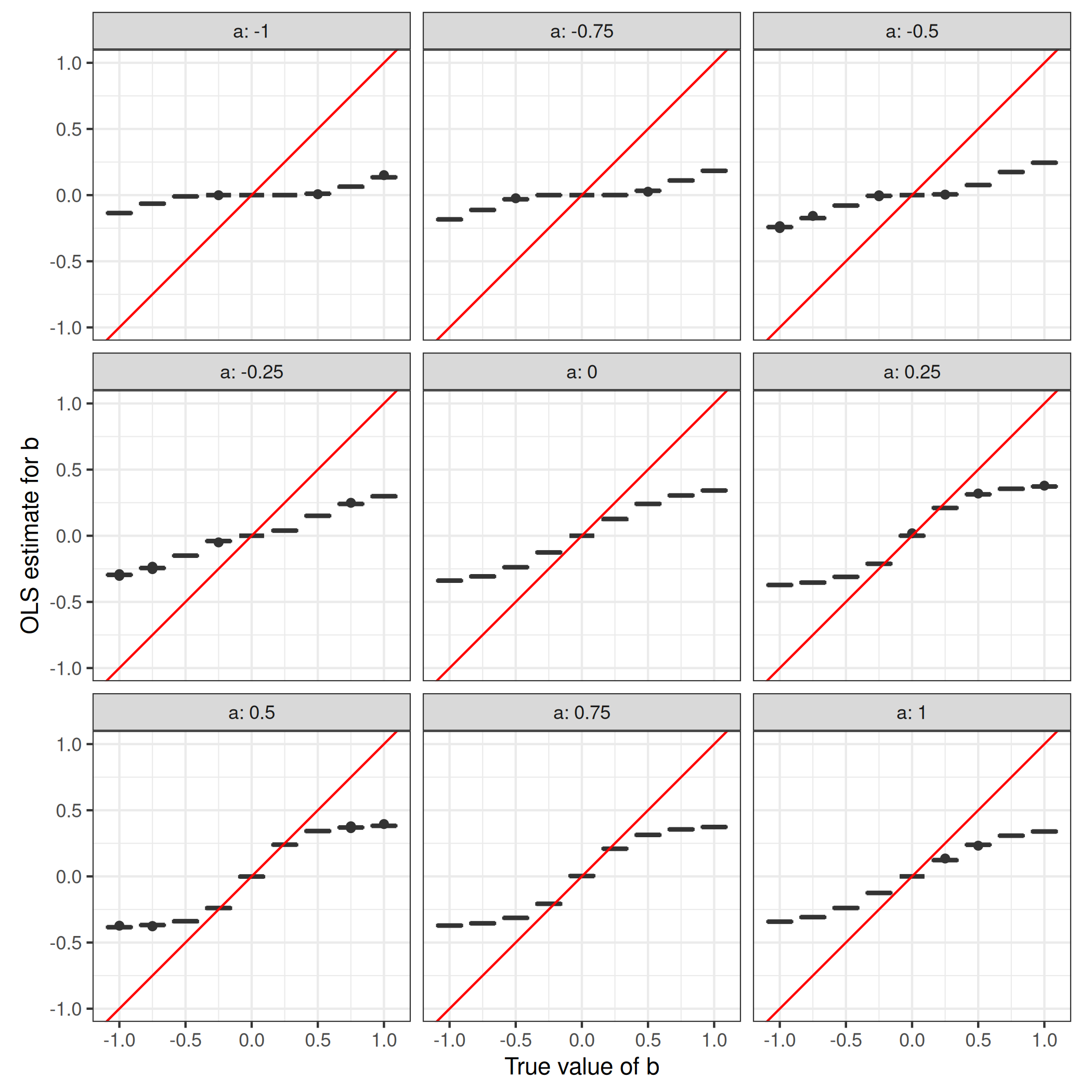
In March this year I presented a paper based on this simulation study on the conference of the Methodology Section of the German Political Science Association (DVPW) in Hannover. (More Information about this converence can be found here.) In this paper, I make the additional argument that OLS estimates of a linear probability model are usually biased. This nullifies an apparent advantage of linear probability models, namely that the computation of their coefficients is simpler than the computation of logistic regression coefficients. Information on this paper can be found here.
I plan to substantially revise this paper by attacking the flaws of the linear probability model in a more direct way.
As a kind of preview: The following picture shows results of a simulation study that compares OLS estimates of the coefficient of a variable where the data are generated according to a linear probability model. It clarifies that OLS estimates are biased even if the LPM is the correct model.